I just finished reading an article in today's New York Times, Arts as Antidote for Academic Ills, (12/19/2012, your reading registration access may vary).
Self portrait, 1997
I love Chuck Close. (Charles Thomas Close; he apparently wished that he'd been able to use the professional name Charles, but everyone now knows him as Chuck...This link is to wikipedia which has done an excellent job of compiling links to interviews and pages. I recommend the Pace Gallery page for an easy overview and the Smithsonian Archive of American Art for an oral history interview for biography/thoughts).
I'm not a tremendous fan of his art, though I appreciate the work that goes into the photo-realistic work that he does. I find myself stuck usually at the point of "Wow, that's amazing drawing"; I like that the size of the work makes his subjects monumental and uncompromising. But I'm afraid that they don't move me to think about who the individual is as a personality, as a subject.
But Chuck Close as an artist moves me.
Close was born with prosopagnosia, a disorder where faces are unrecognizable. One coping mechanism is often to work with small segments of the face, combined with other traits such as voice or walk, to help identify people. Close's work, dividing the face into small parts to focus on it pore by pore almost, is a way to take that "disability" and turn it into art.
Many folks with prosopagnosia, and Close is one, also find that they also have trouble reading and writing; dyslexia is a common linked problem, perhaps because there is a certain amount of object recognition in language (?not an expert). Close was lucky enough to have art as a way of going through school; in the article, he discusses turning in a mural design of the Lewis and Clark trail instead of a paper.
"I figured out what I had left and I tried to make it work for me. Limitations are important."
Close is now in a wheelchair, stemming from an event in 1988 where a spinal artery collapsed. He continues to work, using a tricked out wheelchair and specially designed brushes and hand supports.
The article is about him speaking to students at the Roosevelt School in Bridgeport CT.; the school uses arts programs (the Turnaround Program) to help develop students' academic skills. In a place where 80% of students read or do math below grade level, this is a huge commitment to teaching and learning differently. This is only something that can be done as a labor of love and belief, with lots of sweat and commitment. Money. It's a way of teaching differently, something that has been on my mind always and in particular with the focus on Adam Lanza as a student before the Newtown massacres (no links; I cannot bear it).
But part of what inspires me about Close is how art functions in his life. "There is no artist who enjoys what he does every day more than I do. ...Inspiration is for amateurs. The rest of us just show up for work." He has found the way art expresses his very self, the way it stands in the "gaps" of how he functions, that helps him interact with the world. I would argue that this is the inspiration in his work. But in making art part of his person, it's work--every day is a joy and a chore. The art is a thing he does that makes him happy but because it is part of his whole being he has days when it is work, when it is just the very same as being in your body and standing at a sales counter or on the factory floor or at the desk.
It seems to me that Close got lucky--a combination of perseverance and understanding on his own part, understanding mother, some sympathetic teachers (mixed in with the "sticklers", his word from the interview), finding art as an outlet. I hope that because of his activism and public attention to learning and art other kids will "get lucky". And it's important that kids find Close's ideas early--know what your limits are and use them, push them, and work at it every day. It's hard for me--I teach kids who are often settled in their academic ways by the time they reach me and my own nature is to be what Close would call a "stickler"--I love words so it's hard not to embrace papers and reading and writing; I want my students to love to express art and art history but my natural inclination is for words. I want my students to have that ability to read and write because the world is bigger for having stories to go with the pictures, if you see what I mean. But maybe there's a place in between for being sensitive to students who have difficulty and finding ways to stretch the place where they struggle, while using art to inspire them (if there isn't, I'm in the wrong biz...)
We all know that Art is not truth. Art is a lie that makes us realize truth, at least the truth that is given us to understand. The artist must know the manner whereby to convince others of the truthfulness of his lies. ~Pablo Picasso
Wednesday, December 19, 2012
Tuesday, November 27, 2012
Deciphering our Transition to the Undiscovered Country
I am fascinated by funeral practices. This is an initial exploration...
It has often been said that modern Americans are not good at
accepting death, in part because we cultivate better living standards, medicines,
and cosmetics, reject the processes of physical decay and grief, and embrace a
media culture of death as painless/quick/surrounded by family and friends in a
halo of stage lights/a transitory moment ignored in the necessary welcome to
the company of heaven. There is no doubt
that we individually recognize that death is a lot more real, often accompanied
by shock and fear and anger and pain and mess.
And while there are some cultures that are “better” at death, I think it’s
wrong to create an impression that this makes death any easier for the
grieving.
Funerary practices are the ritualization of death. They may ostensibly be for the dead—to ease
the transition to the next world—but they are constructed by the living for the
living. If we think of Sutton Hoo, the 7th
century boat burial was clearly about constructing a tableau for those
remaining. The mode of burial was meant
to evoke Scandinavian boat burials, to emphasize the connection to this
ethnicity and its heroic burial form.
The coins sent off the dead man in a way that also emphasized the
connection to the Merovingian monetary cultures around them. The metalwork was created in the local
Hiberno-Saxon technique using the interlace of fantastic beasts but also using
addorsed beasts on either side of a man, a motif taken from Scandinavian
metalwork, and bird motifs from fibulae seen in cultures like the
Lombards. The silver bowls and baptismal
spoons were about visible wealth, cosmopolitan interaction with established
empires like the Byzantines, and perhaps a hedging against the possibility that
the fledgling Christian culture was right about the afterlife. It is entirely likely that the site remained
uncovered for a time—a month?—for the viewing of the body and goods, before
being covered by the barrow.
This blog entry was sparked by a passing article about 12 pre-Hispanic
burials from around 1000 discovered in Nayarit, Mexico. (I want to specify that I know NOTHING about
this period or culture and there’s little more info available about this site
at this time. I’m curious though) The burials were in a volcanic area, covered
by lava and hence preserved. (Did they
know that the site would be covered? Was this a deliberate choice?) The bodies
were interred in basalt boxes built of 8 stones (why 8?); it interests me that
there was intentional fragmentation of the stones on the tops (what does this
mean? Fragmented before? Fragmented during the installation of bodies? After,
perhaps to release the spirit of the dead?).
There were also bodies interred around the boxes and in clay vessels
buried in the boxes. According to the
article, this kind of burial is unknown in the area—with shaft tombs and clay
vessel burials the standard. (Why change
form? This seems to suggest multiple
status of burials—families? Gendered? Social rank?)
image from: http://www.arqueomex.com/S2N3nMalinches108.html
Inside one of the boxes were found two Mazapan
style figurines, about 11 inches tall, female, with blouses, skirts, headdress,
earflaps, bracelets, with red pigment on them.
(Why only two? Were these bodies special? Were the deceased in these
graves female? Are the figures just “standing figures” or the goddess Xochiquetzal (who seems to have been a fertility figure)? Protectors?
Indications of larger cultural identity?
So much I don’t know.) I did
learn that there was a lot of commercial travel across Mexico at this point
(ca. 800-1000), resulting in Mazapan style figures deposited as far away as El
Salvador (which Cherra tells me tends to go south not north...). I’ll undoubtedly go hunt down
my friend and colleague Cherra Wyllie for some help (wow, do I have a lot more
questions now, even though this isn’t her area.
Children buried with toys with wheels in an area where wheeled carts and
pottery wheels aren’t used? Women’s goods and imagery vs. men’s…)
What we take with us in our graves tells
something very important about the way others relate to us. If we are buried with our wedding rings or
without, it could be taken either way as valuing the marriage as valued to the
death. There's the issue of being buried in a way that makes the individual seem like his/her self--glasses on, favorite dress (interesting audio programme on this with Dr. Sheila Harper on BBC, about 13 min in). We tend to want funerals/burials to erase the death--does this make the person complete for the afterlife?. Perhaps because we don’t have a
consistent practice of burial that says the same to all viewers. Perhaps because there are so many things that can be buried with us--there isn't a particular style of brooch or knife that resonates across cultures. Perhaps because we're afraid of talking about what we want death to be socially...
Thursday, October 4, 2012
I don't know much about art but I know what I like
The Art Genome Project
Like its musical sister, Pandora (of which I am a big user; happy enough though I wish there were more different offerings but it has been growing), the idea is that you input the name of an artist you like and the genome will link you with others who are similar. The theory argues that there are defining characteristics of art that, like the instruments/beat/vocal quality/lyrics of music, if you quantify enough of the characteristics of enough of the input items you can create links.
Of course, the idea is not to leave it just in the theoretical "What kind of art do you like?" stage but to draw more folks in to the art world. Just as with Pandora, the idea is to sell the work of the artists by expanding familiarity and expanding access.
I like the art of Roy Lichtenstein. I "follow" him, as I would on Twitter (or choose him as a root as I do with Pandora). In addition to being able to browse some of the works of his listed (and there's a good interface for basic info and zooming), I get linked to other artists. The link now gives me updates for Jim Dine, William Eggleston, and Steve Lambert; I can see upcoming shows, thumbnails, and if there are works for sale, I can get in touch with MY DEDICATED SPECIALIST (yup, an art history major all my own who will help me begin my collecting.)
How does it make money? They're partnered with galleries directly (not with artists) and receive 3% of sales that come through their specialists/site. (I don't know if they get that $ on the listing so that even if I walk in to the gallery and fall in love with a work and buy it on sight. It would make some sense...) Theoretically, the larger they grow, with connections to more and more galleries, they could make enough money to do well.
What do I like about it?
* They seem to have purchased/legally obtained their works on the site. You cannot download the images. Copyright of images is a tough legal area (and one with things I would like to change but for now, compliance with the law is good).
* I like the ability to both search and browse as I build my roots--there's a lot of paths one could take to building a personalized collection.
* I don't really know enough about computer engineering to get this but I am intrigued with the amount of open software they're using; interested folks should check out their blog.
What do I not like about it?
* I realize they're in invitation-only Beta mode but when I requested an invitation, the first e-mail I received was "Sign up 15 of your friends to get faster access". I'm not going to spam my friends, folks. (though if you want an invite, ask me.)
* The interface is not exactly intuitive. It can be difficult to navigate from one form to another, to go from search mode, to browse mode, to update page.
* I have limited access to changing my genetic offspring. With Pandora, I may input "The Smiths" and get "Echo and the Bunnymen" as an offspring; I am allowed to vote thumbs-up/thumbs-down on each individual song so that I don't have to listen to a song by Echo that I hate but may still get others by them and may get offspring related to them as well as the Smiths. Art.sy does not let me look at the connections and say "I hate Jim Dine (for example, not for true)" and block him from my update feed. So currently: by inputting Ai Weiwei, I now have a calligraphic traditional Asian art show listed on my feed of upcoming shows. The project gets better with more opportunities to refine it.
I find it an interesting project theoretically. I find this logarithm of "If you like X, you might also like Y" a really fascinating aspect of modern consumerism. I'm interested in the idea of traits that might help make connections between artists, especially when one goes circuitously from Jan Van Eyck to Gregory Crewdson (a connection made for me which has me scratching my head a little).
As Wired magazine pointed out, there's a lot of money potentially to be made here.
Like its musical sister, Pandora (of which I am a big user; happy enough though I wish there were more different offerings but it has been growing), the idea is that you input the name of an artist you like and the genome will link you with others who are similar. The theory argues that there are defining characteristics of art that, like the instruments/beat/vocal quality/lyrics of music, if you quantify enough of the characteristics of enough of the input items you can create links.
Of course, the idea is not to leave it just in the theoretical "What kind of art do you like?" stage but to draw more folks in to the art world. Just as with Pandora, the idea is to sell the work of the artists by expanding familiarity and expanding access.
I like the art of Roy Lichtenstein. I "follow" him, as I would on Twitter (or choose him as a root as I do with Pandora). In addition to being able to browse some of the works of his listed (and there's a good interface for basic info and zooming), I get linked to other artists. The link now gives me updates for Jim Dine, William Eggleston, and Steve Lambert; I can see upcoming shows, thumbnails, and if there are works for sale, I can get in touch with MY DEDICATED SPECIALIST (yup, an art history major all my own who will help me begin my collecting.)
How does it make money? They're partnered with galleries directly (not with artists) and receive 3% of sales that come through their specialists/site. (I don't know if they get that $ on the listing so that even if I walk in to the gallery and fall in love with a work and buy it on sight. It would make some sense...) Theoretically, the larger they grow, with connections to more and more galleries, they could make enough money to do well.
What do I like about it?
* They seem to have purchased/legally obtained their works on the site. You cannot download the images. Copyright of images is a tough legal area (and one with things I would like to change but for now, compliance with the law is good).
* I like the ability to both search and browse as I build my roots--there's a lot of paths one could take to building a personalized collection.
* I don't really know enough about computer engineering to get this but I am intrigued with the amount of open software they're using; interested folks should check out their blog.
What do I not like about it?
* I realize they're in invitation-only Beta mode but when I requested an invitation, the first e-mail I received was "Sign up 15 of your friends to get faster access". I'm not going to spam my friends, folks. (though if you want an invite, ask me.)
* The interface is not exactly intuitive. It can be difficult to navigate from one form to another, to go from search mode, to browse mode, to update page.
* I have limited access to changing my genetic offspring. With Pandora, I may input "The Smiths" and get "Echo and the Bunnymen" as an offspring; I am allowed to vote thumbs-up/thumbs-down on each individual song so that I don't have to listen to a song by Echo that I hate but may still get others by them and may get offspring related to them as well as the Smiths. Art.sy does not let me look at the connections and say "I hate Jim Dine (for example, not for true)" and block him from my update feed. So currently: by inputting Ai Weiwei, I now have a calligraphic traditional Asian art show listed on my feed of upcoming shows. The project gets better with more opportunities to refine it.
I find it an interesting project theoretically. I find this logarithm of "If you like X, you might also like Y" a really fascinating aspect of modern consumerism. I'm interested in the idea of traits that might help make connections between artists, especially when one goes circuitously from Jan Van Eyck to Gregory Crewdson (a connection made for me which has me scratching my head a little).
As Wired magazine pointed out, there's a lot of money potentially to be made here.
Monday, September 24, 2012
Farewell Ferragamos, Pensees about Prada
EDIT: In a twist, the day after the story of their destruction, the Philippine government issued a statement that the clothes were of no historical value except for some Philippine-designed gowns. I find this interesting as a statement of political theatre--the left-behind excesses went on display as a statement of that abuse of power and the ruins of those excesses are dismissed to cover the larger problem of state underfunding of museums and disrepair of facilities.
There was a story today about the decay of Imelda Marcos' shoes and clothing in the National Museum in Manila.
So much of this interests me:
I remember Imelda Marcos as beautiful and her husband's dictatorship in the Philippines as cruel and corrupt. I remember the shopping trips of the 1980s as she came to America and bought her way across Manhattan. I remember the People Power Revolution of Corazon Aquino. And of course, I find her worming her way back into politics in 2010 House elections incomprehensible.
The culture of shoes is one that I stand (hee hee) on the outside of. Part of me is the sturdy practical shoes that don't hurt my feet; part of me wishes Birkenstocks came with sparkly bows. I cannot comprehend the fashion because I get stuck on how much my feet would hurt and how clumsy I would be. I love that there is such a focus on footwear though as an aspect of our cultural and personal expression.
The issues of collection (not acquisition) are also interesting to me. On the things abandoned: "Also listed were 508 floor- length gowns, 888 handbags and 71 pairs of sunglasses. The final tally on Imelda's shoes was 1,060 pairs, less than the 3,000 originally reported." (1987; You can't read more unless you're a Time subscriber.) Putting much of the collection on display was politically important for Aquino and they were taken down when Aquino stepped down in 1992, symbolic of moving on from the immediate politics of rescue. The museum still has 765 pairs that are on display, part of maintaining that history of the Philippines dictatorship for national memory. But the bulk of the collection was moved in 2010 when the Manila's National Museum had problems with termites, humidity and mold in the palace where they were kept. Facilities are a major issue for museums: how much can you keep on display? how much can you afford to store? how much does it cost in terms of labor, effort, and time to move from storage to display to storage? When museums take on objects that they cannot support in their facilities (storing or displaying them off site) the issues are multiplied: what does security look like? transport? daily care?
The issues of conservation are fascinating. Shoes aren't necessarily made of leather any more. Plastics and polyurethanes have really different problems as they begin to degrade: they discolor, crack and break as they lose flexibility, even turning completely to powder. (See the Getty site for a good overview). Barbie dolls (and shoes sometimes) use PVC (polyvinyl chloride) and this becomes sticky over time, attracting oil and dirt in a way that can be stabilized but not reversed. Some mold can be removed; some can't. The water damage here was extensive. So it leads to questions of "what do you save? what do you toss?"
How do you balance historical value against collection and conservation issues? How do you sell history? (could/should the Philippine government legally have sold anything they weren't displaying? would opinion have allowed it? would the pittance they would have made have offset the expenses of preparing them for sale and shipping etc.? would it not have been unethical to sell collections for any other reason than for buying new collections?)
Just some thoughts.
There was a story today about the decay of Imelda Marcos' shoes and clothing in the National Museum in Manila.
So much of this interests me:
I remember Imelda Marcos as beautiful and her husband's dictatorship in the Philippines as cruel and corrupt. I remember the shopping trips of the 1980s as she came to America and bought her way across Manhattan. I remember the People Power Revolution of Corazon Aquino. And of course, I find her worming her way back into politics in 2010 House elections incomprehensible.
The culture of shoes is one that I stand (hee hee) on the outside of. Part of me is the sturdy practical shoes that don't hurt my feet; part of me wishes Birkenstocks came with sparkly bows. I cannot comprehend the fashion because I get stuck on how much my feet would hurt and how clumsy I would be. I love that there is such a focus on footwear though as an aspect of our cultural and personal expression.
The issues of collection (not acquisition) are also interesting to me. On the things abandoned: "Also listed were 508 floor- length gowns, 888 handbags and 71 pairs of sunglasses. The final tally on Imelda's shoes was 1,060 pairs, less than the 3,000 originally reported." (1987; You can't read more unless you're a Time subscriber.) Putting much of the collection on display was politically important for Aquino and they were taken down when Aquino stepped down in 1992, symbolic of moving on from the immediate politics of rescue. The museum still has 765 pairs that are on display, part of maintaining that history of the Philippines dictatorship for national memory. But the bulk of the collection was moved in 2010 when the Manila's National Museum had problems with termites, humidity and mold in the palace where they were kept. Facilities are a major issue for museums: how much can you keep on display? how much can you afford to store? how much does it cost in terms of labor, effort, and time to move from storage to display to storage? When museums take on objects that they cannot support in their facilities (storing or displaying them off site) the issues are multiplied: what does security look like? transport? daily care?
The issues of conservation are fascinating. Shoes aren't necessarily made of leather any more. Plastics and polyurethanes have really different problems as they begin to degrade: they discolor, crack and break as they lose flexibility, even turning completely to powder. (See the Getty site for a good overview). Barbie dolls (and shoes sometimes) use PVC (polyvinyl chloride) and this becomes sticky over time, attracting oil and dirt in a way that can be stabilized but not reversed. Some mold can be removed; some can't. The water damage here was extensive. So it leads to questions of "what do you save? what do you toss?"
How do you balance historical value against collection and conservation issues? How do you sell history? (could/should the Philippine government legally have sold anything they weren't displaying? would opinion have allowed it? would the pittance they would have made have offset the expenses of preparing them for sale and shipping etc.? would it not have been unethical to sell collections for any other reason than for buying new collections?)
Just some thoughts.
Sunday, September 16, 2012
Museums and Missions: IAE at WKU
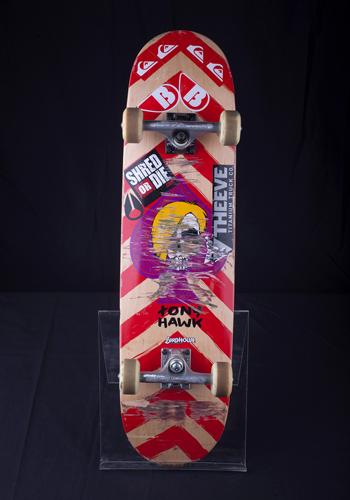
Tony Hawk, skateboard
It's an interesting idea: collect and exhibit ordinary objects that have been used to do extraordinary things. That's the idea behind the collection at Western Kentucky University's museum exhibit, Instruments of American Excellence. They've got Sandra Day O'Connor's bound copy of the Constitution from her chambers, Jimmy Carter's hammer from Habitat for Humanity projects, Liza Minelli's shoes from "The Act" (1977-8) for which she won a Tony. Among many other things.
I think that it's an interesting idea from a collection standpoint--ordinary objects made interesting by provenance. Where the object has been and what it has done. But that doesn't make it any different really than the Smithsonian's collection of things like Julia Child's kitchen or the muppets from Henson studios.
What makes this collection stand out for ME is the idea that it is a college collection. The idea that it is deliberately aimed at students, trying to decide what it is that they want from their lives and what matters to them. I think it's amazing to reach these students with a permanent collection based around aspirations and hard work--like Sara Means' ballet slippers, overcoming adversity--material from Temple Grandin's work, opportunity--a studio mic used by Sam Phillips to record Elvis Presley and Johnny Cash, unexpected paths and changes--the hammer that Jimmy Carter used (the idea of his post-presidency being a new direction and an area for recognition that few could have seen in the presidency years). I hope they find ways to use it well as part of their teaching mission.
It's an interesting idea: collect and exhibit ordinary objects that have been used to do extraordinary things. That's the idea behind the collection at Western Kentucky University's museum exhibit, Instruments of American Excellence. They've got Sandra Day O'Connor's bound copy of the Constitution from her chambers, Jimmy Carter's hammer from Habitat for Humanity projects, Liza Minelli's shoes from "The Act" (1977-8) for which she won a Tony. Among many other things.
I think that it's an interesting idea from a collection standpoint--ordinary objects made interesting by provenance. Where the object has been and what it has done. But that doesn't make it any different really than the Smithsonian's collection of things like Julia Child's kitchen or the muppets from Henson studios.
What makes this collection stand out for ME is the idea that it is a college collection. The idea that it is deliberately aimed at students, trying to decide what it is that they want from their lives and what matters to them. I think it's amazing to reach these students with a permanent collection based around aspirations and hard work--like Sara Means' ballet slippers, overcoming adversity--material from Temple Grandin's work, opportunity--a studio mic used by Sam Phillips to record Elvis Presley and Johnny Cash, unexpected paths and changes--the hammer that Jimmy Carter used (the idea of his post-presidency being a new direction and an area for recognition that few could have seen in the presidency years). I hope they find ways to use it well as part of their teaching mission.
Wednesday, August 29, 2012
Gabriel Dawe: A new artist for me
Through the site Colossal, I found the work of Gabriel Dawe, whose thread installations
Gabriel Dawe, Plexus series (more at Dawe's own site)
remind me a lot of the work of minimalist art of Dan Flavin
I like the way the thread is itself sculpture and the way the space and light are transformed by seeing through the thread.
Though thread is Mr. Dawe's primary medium, the sculptural piece, Don't Ask Don't Tell, is very powerful--a visualization of how policies may seem normal on the exterior but the damage they do to the psyche is considerable:
Gabriel Dawe, Air Force/ Don't Ask Don't Tell, 2010, pins and boots
Gabriel Dawe, Plexus series (more at Dawe's own site)
remind me a lot of the work of minimalist art of Dan Flavin
I like the way the thread is itself sculpture and the way the space and light are transformed by seeing through the thread.
Though thread is Mr. Dawe's primary medium, the sculptural piece, Don't Ask Don't Tell, is very powerful--a visualization of how policies may seem normal on the exterior but the damage they do to the psyche is considerable:
Gabriel Dawe, Air Force/ Don't Ask Don't Tell, 2010, pins and boots
Saturday, August 11, 2012
Artwork: St. Claire
Click here or the image to go to Met's entry.
The Bishop of Assisi Giving a Palm to Saint Clare, 1350, German, tempera and gold on panel
This is a fine example of what I like in Gothic art--
1. highly narrative (the bishop extended the palm to her specifically on Palm Sunday, as part of her choice to enter communal life; it is clearly also meant as a reference to her future sainthood).
2. figures in the International Gothic Style: delicate, swaying bodies, elongated hands with thin curving fingers, sweet precious faces.
3. even the grotesque stigmata on St. Francis's hands are cute little red dots
4. the beautiful tooling of the gold in the background--heavenly setting, luxury cues
5. the introduction of naturalistic elements--perspectival rendering of the book that hangs over the edge of the table, shading in the folds of the altar cloth.
1350 is a pivotal artistic point: right on the wake of the devastation of the Black Death, situated in the luxury of the past (though celebrating here figures who gave up their wealth specifically to be part of the Church--and who worked for the institution itself) as well as the hinted styles of the Renaissance.
Subscribe to:
Posts (Atom)